IT security, Zero Trust, IPCEI-CIS
Security starts at the device
Why endpoint and device security is the foundation of Zero Trust in the cloud-edge continuum – TPM, attestation, and measurable integrity.
In the cloud-edge continuum the classic perimeter dissolves. Servers no longer live only in data centres, but on factory floors, cell towers, and in public space. Relying on network boundaries there is building on sand.
Hardware as the anchor of trust
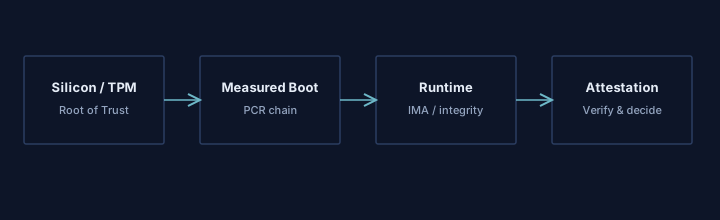
Software security depends on platform integrity. If the device is compromised, even strong IAM or network controls buy you little. You need a hardware root of trust – typically TPM 2.0 – and a verifiable chain of measurements:
- An immutable firmware root measures the bootloader
- The bootloader measures the kernel and critical components
- Runtime measurements (e.g. IMA) extend the chain
- A verifier appraises attestation before granting access
A simple integrity check can be thought of as a hash chain. If is the first measurement and a cryptographic hash function:
Any deviation changes the register value – and therefore the attestation.
What this means in practice
For edge and far-edge modules that means:
- Bind device identity to silicon (not easily cloned software IDs)
- Secure/measured boot with anti-rollback
- Physical and logical tamper evidence where devices run unattended
- Feed telemetry and integrity evidence back into SecOps
This is not an academic model. It is the technical prerequisite for EUCS High and credible digital sovereignty.
Further reading
In the Collaborative Security Framework (CSF) of the 8ra Cross-Workstream on Security, Endpoint & Device Security is spelled out as its own topic – including partner building blocks.