Updated IT security, Cloud, Incident response
Stolen API keys on AI developer platforms: can your PaaS provider read your secrets in plaintext?
Since October 30, Northflank has told all customers to treat their environment variables as decrypted. Wiz counts at least nine incidents at AI developer platforms in October and two cases of stolen AWS Bedrock keys. What environment variables, KMS, BYOK and workload identity each protect, and which secrets to rotate today.
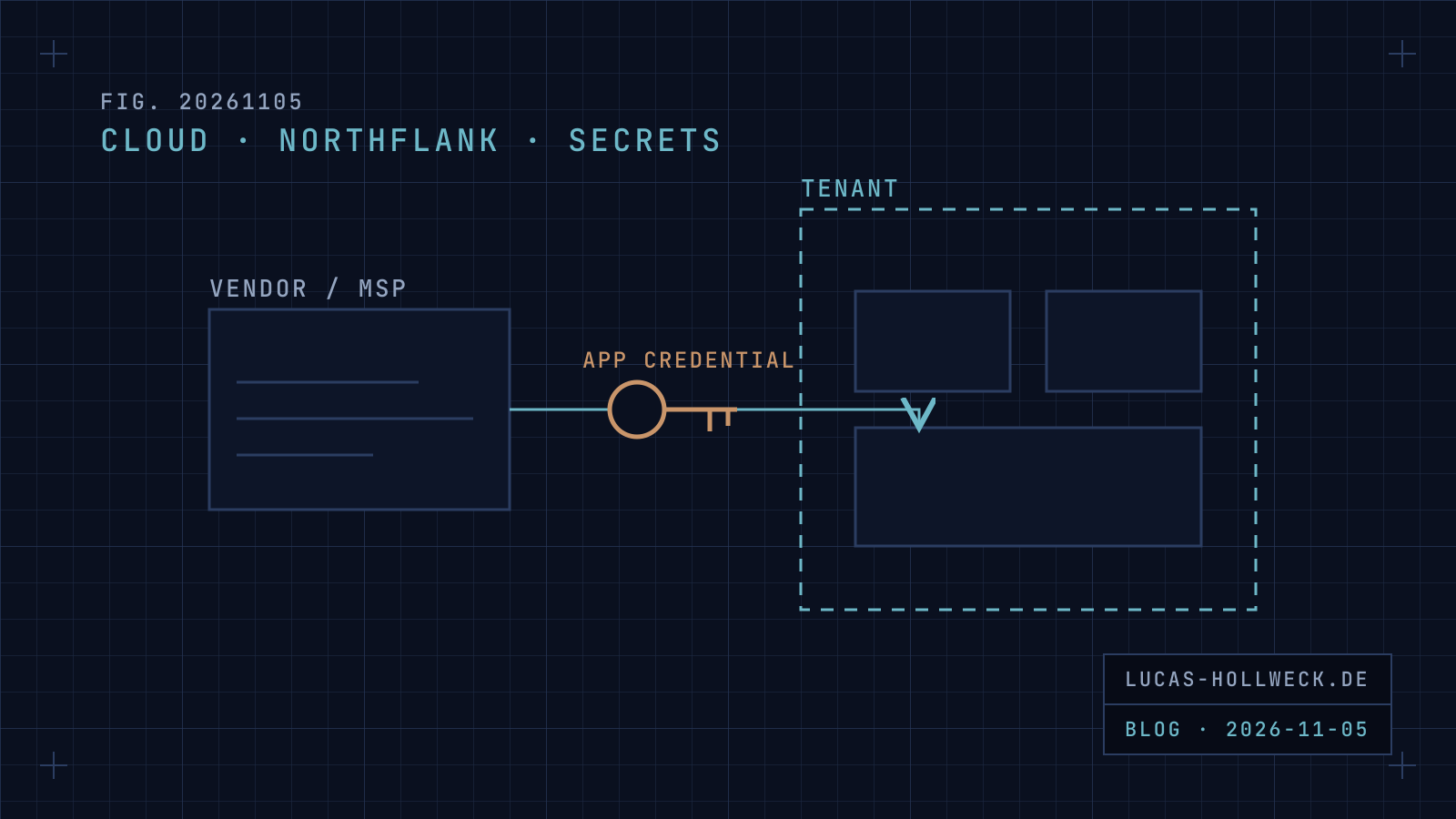
Update November 20, 2026, 08:07 CET. On November 10, Railway published its final report on the October attack; the key points are in the update further down. On November 17, Northflank published its own incident report. This update does not cover that report.
As of November 5, 2026, 1:21 p.m. CET. Northflank has not yet published a root cause analysis. Since November 2, its status page has listed the incident as “Monitoring”.
On October 30 at 13:40 UTC, Northflank told customers on its status page to rotate their environment variables immediately. Eighteen minutes later came the sentence that defines the incident: all customers should assume their environment variables had been decrypted. Northflank is a platform on which teams run containers, databases and AI workloads without maintaining their own Kubernetes clusters. Overnight, customers reported that AI API keys they had stored on Northflank were being used by someone else.
On November 2, Northflank summarized where things stand. By its own account, the attack vector was contained within an hour of the first alert, the evidence points to secrets held in the control plane, and running workloads were not affected. Customers on dedicated or forward-deployed control planes were not affected either. Independent forensic auditors are reviewing the incident. Northflank intends to publish a root cause analysis once its findings are confirmed. Separately, the vendor reports patching the Linux kernel vulnerability CVE-2026-98432 across its fleet. It does not say whether that is connected to the breach. As of today the root cause is open.
Northflank was not the only case in October. In its “Black October” report, Wiz counts at least nine AI developer platforms that disclosed incidents during the month, among them Fireworks AI, Railway, Lightning AI, OpenCode and Warp. On November 2 and 3, Wiz added three more reports. Zeabur is shutting down after its incident. The stated causes differ: Wiz lists stolen credentials, privilege escalation in build infrastructure, a third-party dependency and a legacy system. What all public reports have in common, according to Wiz, is that the attackers hunted specifically for stored environment variables, above all those granting access to AI models.
Wiz also describes two cases in which stolen credentials for AWS Bedrock, Amazon’s AI service, were abused. According to Wiz, both keys came from one of the affected platform vendors; the report does not say which. In both cases the first outside test call came within 30 minutes of the reported access at the vendor. In the first case, about 800,000 calls ran over 30 hours, roughly 90 percent of them successful. The second key was allowed to use Bedrock only in US regions. Seven days after the first test it appeared in a pool that apparently resells model access, and it reached about 1.7 million calls in 13 hours, more than a million of them successful. Wiz estimates both cases at more than 100,000 US dollars at list price. Wiz links the keys to resellers through test calls from their infrastructure; the report leaves open who carried out the theft itself. Google Threat Intelligence Group describes this business as LLMjacking and cites individual cases with more than 100,000 US dollars in charges in a single day.
In your own team it often looks like this: for a prototype, someone created an AWS access key with Bedrock permissions and stored the access key and secret key as environment variables at the PaaS provider. Next to them sit an OpenAI key, the database URL with its password and a Stripe key from testing. The prototype is now in production, and the keys are the same.
What the platform can read
The question that matters after this month is: can your platform provider read your secrets in plaintext? The answer depends on how the secret reaches your application.
An environment variable is a value the platform hands to your process at startup. To do that, the platform has to know the value in plaintext, even if it stores it encrypted.
A KMS (key management service) holds cryptographic keys and performs encryption and decryption without ever handing out the key itself.
BYOK (bring your own key, called customer-managed encryption keys at Northflank) means the key the provider uses to encrypt your secrets lives in your KMS, and you can revoke the provider’s access to it.
Workload identity via OIDC means your application presents a signed identity at startup and receives short-lived credentials for it from your cloud account, so no long-lived key is stored anywhere.
With the last option, the control plane holds no long-lived key that your application uses. BYOK changes less than its name suggests. Northflank’s own documentation shows this precisely: by default, Northflank encrypts secrets with its own keys and decrypts them when needed. With BYOK, Northflank asks your KMS to unwrap the data key and then decrypts the secret itself. The platform may cache unwrapped data keys, so KMS logs do not show every read. BYOK is available there for enterprise accounts and was introduced in August and September. Northflank has not said whether BYOK customers were spared. Our reading: BYOK lets you revoke the platform’s access. Until you do, the platform can read the plaintext, and your KMS logs will not show every read.
Northflank offers workload identity for AWS and Google Cloud. The platform sets up an OIDC provider in your cloud account and passes credentials to your workloads that are refreshed before they expire. A stolen value therefore loses its use quickly. The trust relationship in your cloud account remains, though, and after the incident Northflank also revoked customers’ cross-account IAM roles and service accounts. For AI providers that only support static API keys, this route does not exist.
Update November 20, 2026: Railway’s final report
On November 10, Railway published its final report on the attack of October 20 and 21. Until then, only a preliminary notice was available. Everything in this section comes from that report and cannot be verified independently.
According to Railway, the attack began in its build infrastructure, where builds from different customers ran on the same virtual machine. Through a previously unknown vulnerability, the attacker partially escaped filesystem isolation and read a credential that build servers use to authenticate to internal systems. It was meant only for build tasks such as pushing finished images. The internal system that drives builds, however, accepted it as a trusted client. That let the attacker read the stored histories of 353 builds, including their variables, and obtain a copy of Railway’s internal code.
On October 21 the attacker got further through a second route. A misconfigured OIDC binding in a cloud environment gave them short-lived credentials of the CI/CD system. From there they reached a machine that places customer workloads across the fleet. On it sat a longer-lived credential the platform uses to have the cloud provider’s KMS decrypt encrypted variables. Railway encrypts each environment with its own data key, and the root key stays in the KMS. With the platform’s credential, the attacker had the KMS decrypt the variables.
According to Railway’s logs, variables may have been decrypted for at most 1.85 percent of workspaces, about 100,000. The figure is an upper bound because the logs only record which environments were affected. Railway contacted high-risk customers directly. The decrypted data also included linked-account tokens for 1,852 users, among them their own AI keys for agents and GitHub OAuth tokens. Railway has reset them. Railway estimates unauthorized spend on the stolen keys at about 740,000 US dollars and says it will seek refunds or cover the costs itself where a provider does not refund.
According to Railway, database logs show that the attacker filtered variable names specifically for AI provider keys and favored customers with many variables. A further query also matched cloud, database and payment service credentials. Railway says forensics did not indicate access to customer databases. Railway believes the AI keys were passed on through intermediaries and used for distillation, that is, training other models on the outputs of large models. By its own account, Railway has not established whether the attacker runs those services.
Railway says it has closed every weakness that was exploited. Each build now runs in its own ephemeral virtual machine. Only the secrets service can reach the keys, and every other service may decrypt only the credentials it needs.
At Railway, the KMS protected the root key, not the secrets. Whoever held the credential the platform itself uses for decryption could read the variables. If you use Railway and have not rotated the keys stored there since the incident, rotate them now, even if Railway did not email you. Railway asks customers to report unauthorized AI provider charges through the form in its report.
What to do now
- Make a list. For every platform your code runs on: which secrets are stored there, and whether the platform can read them in plaintext. For environment variables the answer is yes.
- Rotate everything on Northflank and the other platforms named. Northflank advises starting with AI keys, cloud credentials, payment provider keys, private keys and database passwords. Rotating means revoking and reissuing with the issuing provider, then reconnecting integrations.
- Check usage with the provider. For AWS Bedrock, review the affected credentials’ calls in CloudTrail since early October; for OpenAI, Anthropic and others, review usage and billing data. Northflank recommends contacting the AI provider directly if you see unexpected usage.
- Move cloud access to workload identity. Where the platform offers it, replace stored access keys with short-lived credentials and restrict the role to the services and regions you need. In the second Wiz case, the restriction to US regions slowed the abuse without stopping it.
- Keep static AI keys small. One key per platform and environment, with a budget alert at the provider and, where possible, a spending cap. That way a leak shows up in consumption, and you only have to rotate one key.
What we do
For every platform, we first ask whether it can read our secrets in plaintext. If it can, we store only credentials there that are short-lived or whose misuse is limited, and we must be able to rotate them within an hour. Where BYOK is offered, we take it as a way to cut off access.
Which of your platforms can read your secrets in plaintext today, and how long would your team need to rotate all of them?